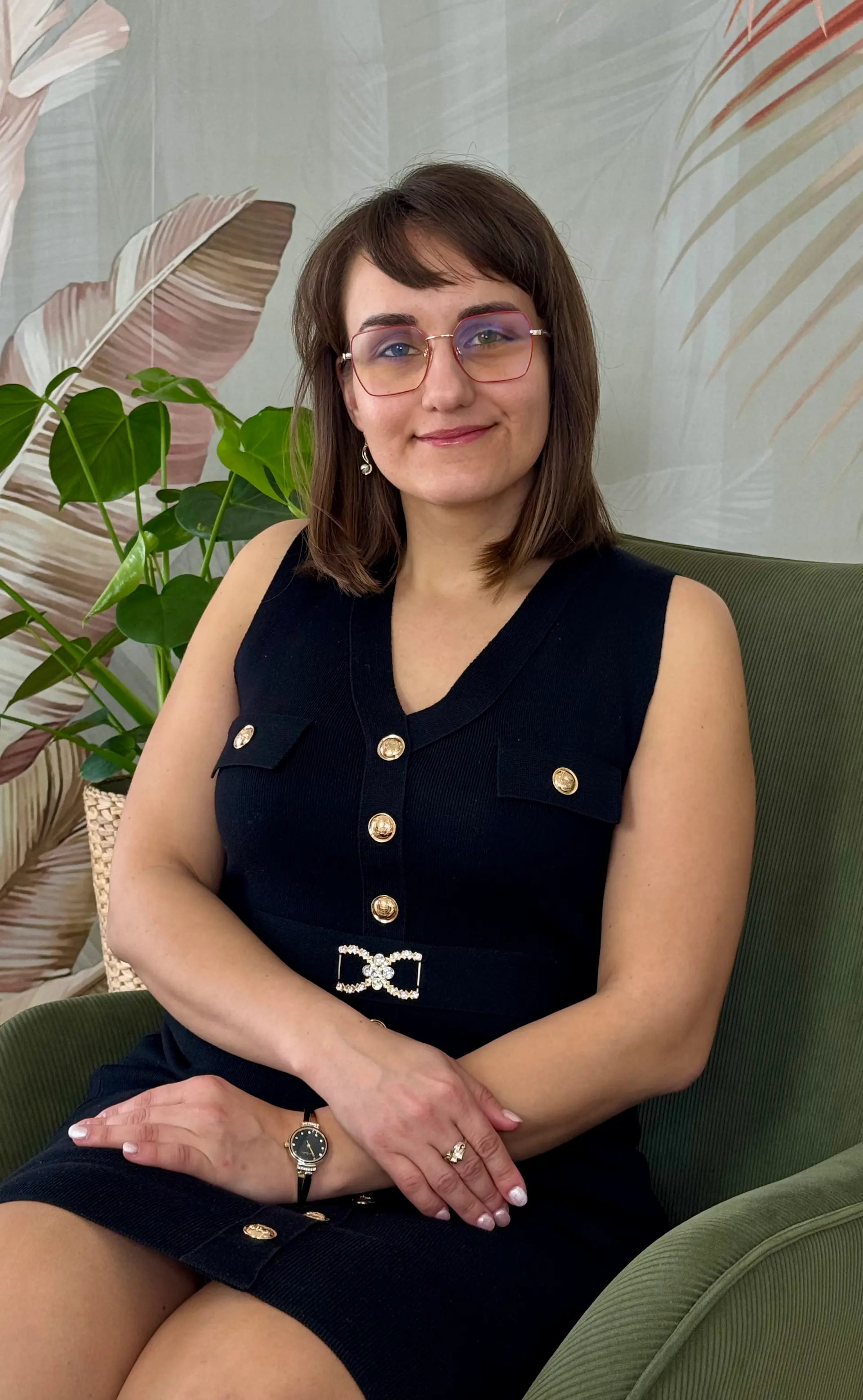
Enikő Varga
Together, we explore what can help you navigate stress, life changes and uncertainty about yourself more confidently.
How I can help
These are the areas I work with most often
How we can meet
Here you can see where and how we can work together
Online from anywhere
Via Google Meet
Languages
Hungarian
Education and professional background
What my professional work is built on
ELTE • Counseling Psychologist (in progress)
SZTE • MA in Psychology specializing in Counselling and School Psychology
Hungarian Association of Individual Psychology • Self-discovery experiential group (150 hours)
About me
A quote I live by
The important thing is not getting out of bed on the right foot, but being able to switch feet when you get up on the wrong one. — Krisztina Hevesi
General cultural enrichment is important and energizing for me. Even as a child, I preferred trips that included museum visits or guided city tours. When I started my psychology degree, my free time expanded to include attending professional events and lectures, as well as eagerly consuming psychology-related online content (articles, podcasts). On top of that, I filled my bookshelves accordingly.
I am fascinated by nature; as an amateur hiker, I love taking long walks outdoors, but I am equally interested in cultural events and spending time with animals. Among sports, I enjoy cycling and swimming. I learn and draw inspiration from my hobbies.

I am an introverted person; I like quiet moments, gathering my thoughts, and unwinding with family or a small circle of friends. It was during upper primary school that I first realized I was drawn to the helping professions, particularly psychology. One of the reasons for this (though not the only one) was that unfortunately, I experienced bullying from my peers.
I thought it would be great to understand what drives human behavior and conflicts, what dynamics operate within a group, and above all, how I could equip myself against difficulties coming from multiple fronts in life.
Over the years, with various goals in mind, I have also visited a therapist myself, gaining firsthand personal experience in the field. I naturally have a humanistic mindset, have been a good listener since childhood, and empathy has proven to be a distinct strength of mine, which is a useful trait in the social field. Even so, finding my life path was a bumpy road. As the first and so far only university graduate in my immediate family, I had many questions and anxieties as a young adult, having embarked on something where I could not rely on guidance. For a long time, I experienced managing success and failure, overthinking, and procrastination as my greatest personal challenges. I even researched procrastination during my university years to overcome it. Ultimately, understanding psychological phenomena and the relentless search for solutions motivated me throughout my studies and my detour-filled twenties.
As a psychologist
I began gaining experience as a helper as a house mother in a residential child and family center during my university years, and later, I was involved in social rehabilitation at a special institution for elderly and disabled adults. I started my career as a psychologist in child protection specialist care. There I worked with children facing challenging situations, some with mild intellectual disabilities, behavior and integration disorders, attachment disorders, ADHD, or other psychiatric or neurological diagnoses, including criminalized adolescents. I conducted individual and group psychological support sessions for them.
Currently, I work at a pedagogical service center, where I participate in comprehensive diagnostics and psychological support for children, from preschool age to young adulthood.
Every child's development may involve challenges, some of which are natural, but there are situations where the involvement of a specialist is necessary. These can include performance-related problems, anger management difficulties, parent-child conflicts, various psychosomatic symptoms, or anxiety, which I encounter regularly in my work. Together with parents, we work on problems affecting their children's mental health, where naturally, the child is the main focus. With adults, I engage in general counseling, consultations with parents and teachers, and through my private counseling, where I mainly work with young adults, adults, and adolescents.
The helping professional works with their personality. Just as I draw energy from my relationships, I believe that in a therapeutic process, it is the human connection that heals first.
My important goal is to deepen our understanding of emerging problems together and find the tools and resources that can help manage difficult situations and achieve personal growth. My perspective is most closely aligned with the humanistic-existential psychology approach. I strive to create an atmosphere of compassion, positive unconditional acceptance, and authenticity. My outlook is holistic, meaning I treat the body and soul as a unity. My working method is always personalized, where I attentively focus on my clients.
My methods include supportive conversation, psychoeducation, imaginative tools, relaxation techniques, but I also try to incorporate cognitive behavioral therapy elements into the process of individual psychological assistance. I am also interested in mindfulness, self-awareness, and assertiveness development.
I believe in the importance of prevention and self-development, as well as the power of good communication and positive reinforcement: “The soul can be healed with a certain magic, and that magic is beautiful words.” (Socrates) Whether you are seeking a psychologist with a specific goal or in need of general support, we can work together online on the small and big problems of your life, as long as you need it.
Areas of expertise
Adult consultation:
parent consultation
general mental well-being
parenting questions
challenges of life with young children
coping with acute stress
negative emotional states
lifestyle-related questions
Adolescent consultation (from age 15):
• strengthening social competencies
• school difficulties
• mood issues
• self-esteem issues, lack of self-confidence
• anger management, reducing aggression
• coping with acute stress
• processing negative, difficult life events